Distributed Healthcare Monitoring System
Secure Systems - Practical Application
What?
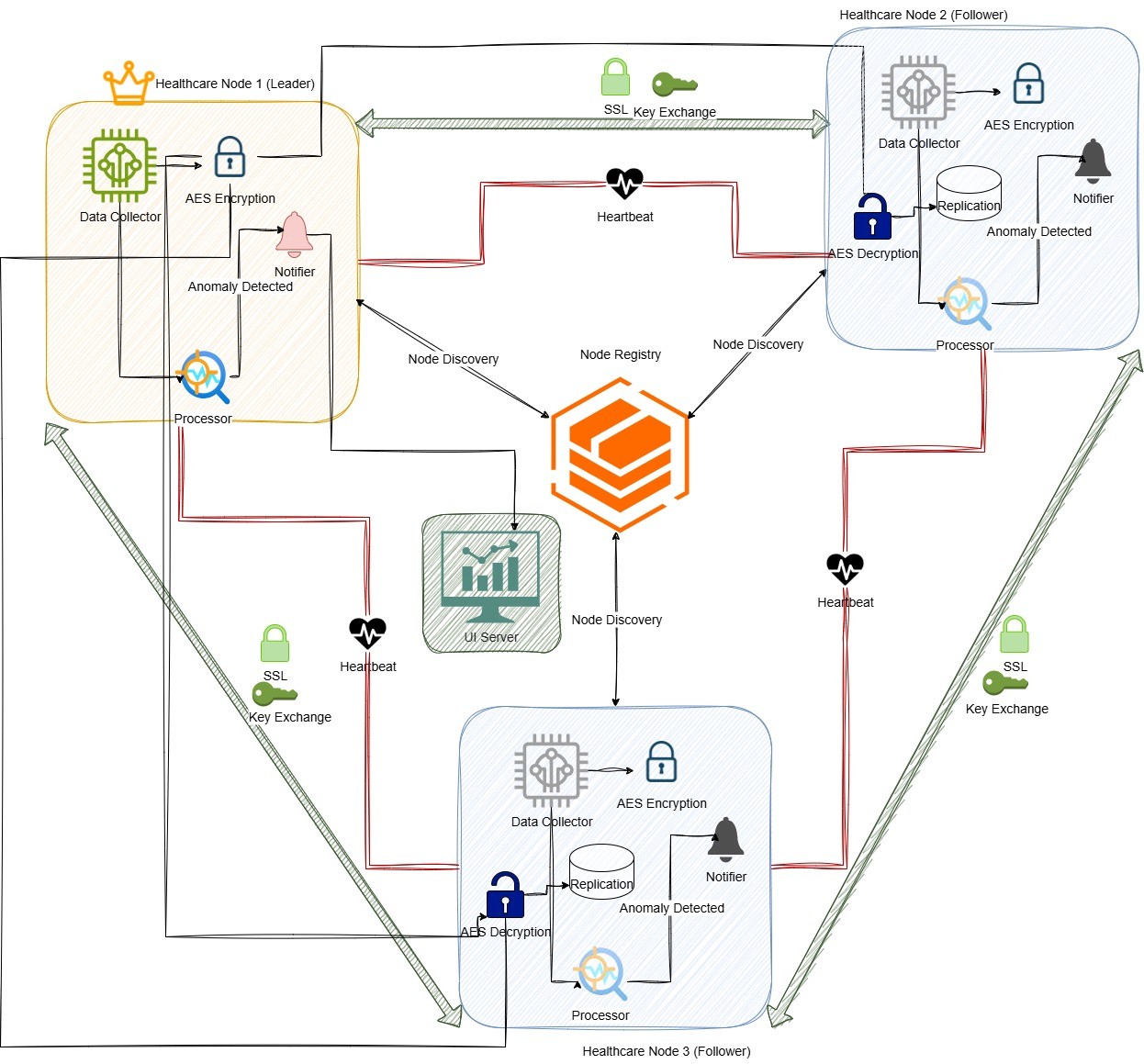
A distributed, real-time health monitoring system engineered with a focus on security, fault tolerance, and high availability. The project involved designing and building a resilient microservices architecture from the ground up to demonstrate core concepts in secure systems engineering.
Why?
In critical domains like healthcare, system downtime or data breaches are unacceptable. This project was designed to tackle these challenges by:
Ensuring continuous operation and data integrity, even when system components fail.
Guaranteeing the confidentiality of sensitive patient data during transmission.
Creating a scalable and resilient architecture that can grow and adapt to changing requirements.
How?
The system was built using a distributed, leader-follower architecture and validated through rigorous quantitative analysis.
SYSTEM ARCHITECTURE & DESIGN
Microservices Model: The system is composed of three independent services: a central Node Discovery Service for dynamic registration, multiple Healthcare Nodes for data processing, and a Web Dashboard for real-time visualization.
Leader-Follower Consensus: The healthcare nodes operate on a leader-follower model. The leader coordinates tasks, while followers replicate data and stand ready to elect a new leader in seconds if the current one fails.
ENGINEERING & SECURITY
End-to-End Encryption: All inter-node communication is secured using SSL/TLS with certificate-based authentication to prevent data interception and ensure authenticity.
Automated Fault Tolerance: The system features automatic health checks and data replication. Node failures are detected in real-time, triggering a leader election process with a failover time of just 3.9 seconds.
Quantitative Stress Testing: The system underwent 24-hour simulations to measure its resilience, capturing key reliability metrics under pressure.
TECH STACK
Backend: Python
Web Framework: Flask
Security: SSL/TLS (OpenSSL)
Architecture: Microservices, Leader-Follower Model
Frontend: HTML/CSS, Tailwind CSS, Chart.js
Outcomes & Reliability Analysis
The quantitative analysis revealed a highly resilient, self-healing system capable of withstanding repeated failures.
Achieved 99.38% System Availability across 24-hour stress tests, demonstrating exceptional uptime even under adverse conditions.
Engineered a Rapid Recovery Mechanism with a Mean Time To Recovery (MTTR) of under 6 minutes and an automated failover of just seconds.
Validated Improving System Stability with an upward-trending Mean Time Between Failures (MTBF), confirming the system became more reliable as it ran.
Suggestion: Embed the Reliability Metrics Chart from your report here. It's a powerful visual that backs up these claims.
Practical Learnings
Bridging Theory and Practice: Gained hands-on experience implementing distributed system concepts like leader election and data replication. Encountered and diagnosed real-world challenges such as concurrency errors and service timeouts that aren't apparent in theoretical models.
The Value of Quantitative Analysis: Learned to move beyond simple "pass/fail" testing by implementing a framework to measure key reliability metrics (MTTR, MTBF, Availability). This provided data-driven insights into the system's true performance and stability.
End-to-End System Validation: Discovered that individual component success doesn't guarantee overall system health. While individual services passed tests, end-to-end analysis revealed bottlenecks in data flow, reinforcing the need for holistic system validation.
Secure Infrastructure Configuration: Acquired practical skills in generating, configuring, and deploying SSL/TLS certificates to establish a secure communication backbone for a distributed application.
Future Enhancements
Implement Raft Consensus: Integrate a formal consensus algorithm like Raft to further strengthen leader election and guarantee data consistency.
Improve Data Synchronization: Develop more robust data replication protocols to increase data flow success rates under heavy load.
Enhance Concurrency Handling: Refine asynchronous operations to improve throughput and eliminate processing bottlenecks.




Links.
© 2025 • Snehasini M Antonious